If you’ve ever sat in a meeting where someone said “we’re doing agile” or “let’s stick with waterfall,” and quietly wondered what the actual difference was, you’re not alone. The agile vs traditional development for startups debate isn’t just industry jargon. It’s one of the more consequential decisions a founder makes, because it shapes how fast your team can adapt, how much gets documented, and how often you actually see working software. Multiple studies across the past decade consistently show agile projects succeeding more often than traditional ones, with success rates for agile ranging from roughly 40% to 70% depending on the study, compared to 15% to 50% for traditional waterfall projects.
This guide breaks down what each approach actually means, why the gap between them exists, and how to decide which one, or which mix of both, fits your startup.
What “Traditional” Development Actually Means
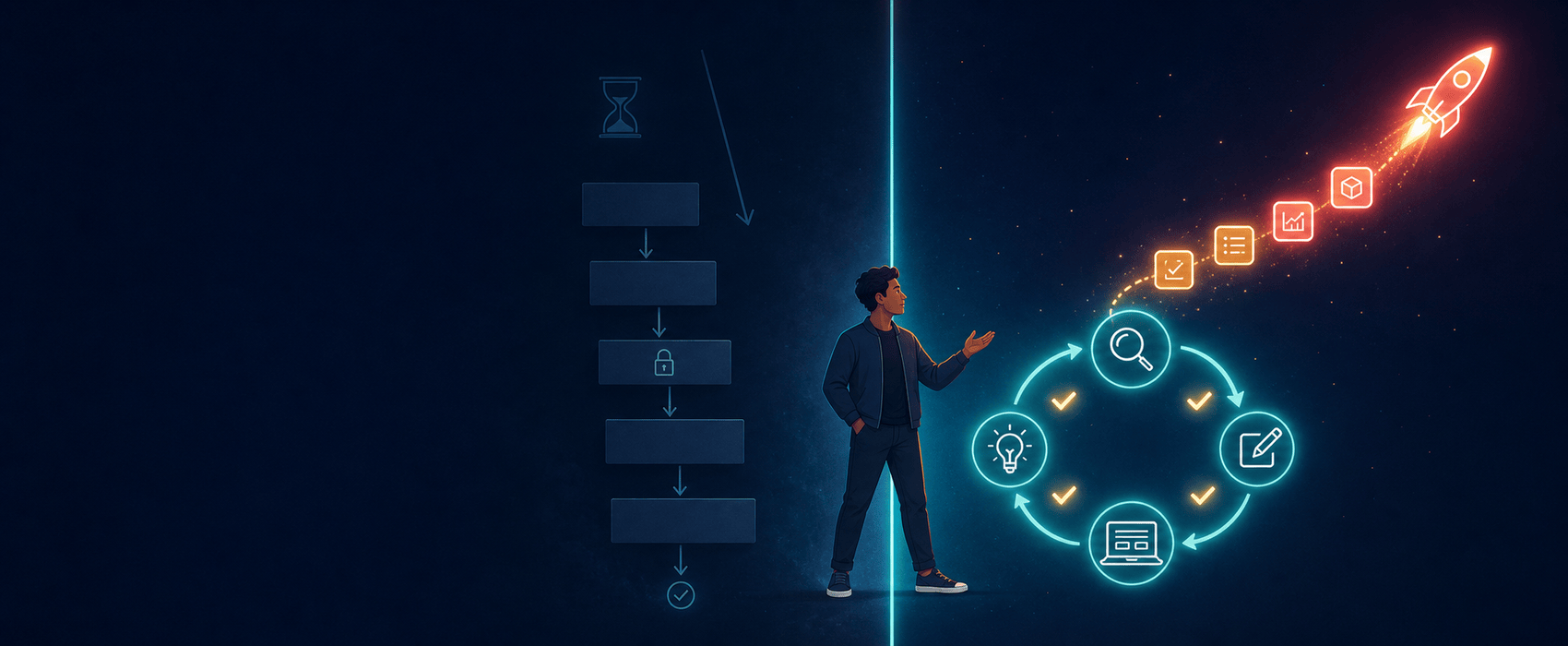
Traditional development, most commonly called the waterfall model, follows a linear, sequential process. Each phase, requirements, design, development, testing, and deployment, happens fully before the next one begins. Think of it like a literal waterfall: water flows downward through each stage in order, and it doesn’t flow back upstream.
This approach comes with clear structure. Every team member has a pre-defined role, every requirement is documented in detail upfront, and every change gets recorded carefully. Testing happens as its own separate phase, usually after the entire application has already been built.
The strength of this structure is also its biggest weakness for startups: it assumes you already know exactly what you’re building before you start. That assumption rarely holds true for a young company still validating its core idea.
What Agile Development Actually Means
Agile development takes the opposite approach. Instead of planning the entire project upfront and building it in one long sequence, agile breaks work into small, repeatable cycles, often called sprints, that typically last two to four weeks. At the end of each cycle, the team reviews what was built, gathers feedback, and adjusts direction before starting the next cycle.
Agile is built around flexibility and customer feedback. As the project develops, priorities are expected to shift based on what the team actually learns, rather than following a plan set in stone months earlier. Multiple phases can also happen in parallel rather than strictly one after another, which speeds up delivery in practice.
Agile vs Traditional Development for Startups: Comparing Success Rates
The research on this comparison is unusually consistent, even though the exact numbers vary by study. A well-known industry survey found agile projects succeeding 64% of the time compared to 49% for waterfall. Separate research has put agile success as high as 70%, against roughly 50% for waterfall, making agile projects nearly 1.4 times more likely to succeed. Other academic comparisons have found an even starker gap, with agile completion rates around 40% versus just 15% for waterfall in certain contexts.
| Metric | Agile | Traditional (Waterfall) |
|---|
| Typical success rate (across studies) | 40% – 70% | 15% – 50% |
| Typical failure rate | 9% – 12% | 29% – 30% |
| Adoption among U.S. companies | Around 70-75% | Declining, but still used |
The exact percentages differ because studies define “success” differently, some measure on-time and on-budget delivery, others measure whether the final product actually met user needs. But the direction of the gap is remarkably consistent across nearly every study: agile methods outperform traditional ones on the metrics that actually matter to a startup.
Why Agile Fits the Startup Reality Better
Startups operate under a specific kind of uncertainty that traditional development wasn’t designed for. You often don’t know your exact feature set, your ideal user flow, or even your final business model when you start building. Waterfall assumes you do. Agile assumes you don’t, and builds that uncertainty into the process itself.
A few reasons agile tends to suit startups so well:
- Faster feedback loops. Short sprints mean you’re showing real, working progress to users and stakeholders every few weeks, not months into the project.
- Room to pivot. If early feedback reveals your assumptions were wrong, agile lets you change direction without scrapping months of finished work.
- Better fit for distributed teams. Agile methodologies work well with remote or distributed development teams, which describes a large share of early-stage startup teams today.
- Reported speed gains. Teams using agile commonly report meaningfully faster time-to-market compared to teams following a strict waterfall process.
When Traditional Development Still Makes Sense for a Startup
Agile isn’t automatically the right choice for every situation, even at a startup. Waterfall, or a more structured approach in general, still has real advantages in specific circumstances:
- When requirements are genuinely stable and well understood. If you’re building a well-defined compliance system or a product with fixed regulatory requirements, a more sequential, thoroughly documented process reduces risk.
- When strict documentation is required. Certain industries, especially healthcare, finance, or government contracting, require detailed documentation trails that waterfall naturally produces.
- When budget and timeline predictability matter more than flexibility. A fixed-price contract with a client who needs a guaranteed delivery date can be easier to manage under a structured, sequential process.
For most product-focused startups still figuring out what their users actually want, these conditions rarely apply in the early stages. But they become more relevant as a startup matures, adds enterprise customers, or enters a regulated industry.
Key Differences at a Glance
| Factor | Agile | Traditional (Waterfall) |
|---|
| Planning style | Iterative, adjusted every sprint | Fixed, planned upfront in full |
| Flexibility | High, built to accommodate change | Low, changes are costly mid-project |
| Documentation | Lighter, focused on working software | Extensive and detailed |
| Testing | Happens continuously throughout | A separate phase near the end |
| Roles | Flexible, often shared across the team | Clearly defined and fixed per person |
| Best suited for | Uncertain, evolving requirements | Stable, well-understood requirements |
Neither column is universally “better.” They’re built for different conditions, and the mismatch between a company’s actual environment and its chosen methodology is usually where problems start.
The Hybrid Approach: Best of Both
A growing number of companies, including many startups as they scale, are adopting a hybrid model that blends agile’s flexibility with waterfall’s structure. In this setup, a company might use agile sprints for day-to-day product development, while applying more waterfall-style planning and documentation for larger, less frequent milestones like a major compliance release or a big client-facing launch.
This hybrid approach has been gaining real traction, with a majority of larger enterprises reportedly shifting toward some version of it. For startups, a lightweight version of this idea, agile for most of the product, with a bit more structure around anything customer-facing or contractually binding, often works better in practice than a rigid, all-or-nothing commitment to either methodology.
How to Choose the Right Approach for Your Startup
- Choose agile if: your requirements are still evolving, you need to ship quickly and learn from real users, and your team is small enough to communicate and adjust direction easily.
- Choose traditional if: your requirements are genuinely fixed, you’re working under strict regulatory or contractual documentation requirements, or you’re delivering a well-defined project for a client who needs guaranteed, predictable milestones.
- Choose a hybrid if: most of your product is still evolving, but specific parts of your business, compliance, enterprise contracts, or major releases, need more structure and predictability than pure agile provides.
Most early-stage, product-focused startups land clearly in the first category. The decision becomes more nuanced as the company grows, takes on larger clients, or enters more regulated territory.
Common Mistakes When Applying Agile at a Startup
- Calling it agile without actually practicing it. Skipping sprint reviews, ignoring feedback loops, or treating the backlog as a fixed plan defeats the purpose of the methodology entirely.
- Constant miscommunication from shifting roles. Agile teams often struggle when roles and responsibilities change too often without clear ownership, leading to confusion about who’s doing what.
- Skipping documentation entirely. Agile favors lighter documentation, not none at all. Some record of decisions and architecture still matters, especially as your team grows.
- Applying agile to genuinely fixed requirements. If a specific deliverable truly can’t change, forcing constant iteration onto it just adds overhead without any real benefit.
- Resistance to change from traditional habits. A notable share of failed agile transitions cite cultural misalignment and resistance to moving away from familiar traditional practices as a leading cause.
Final Thoughts
The agile vs traditional development for startups debate isn’t really about which methodology is objectively superior. It’s about matching your process to your actual level of uncertainty. Startups, almost by definition, are operating with unclear requirements, unproven assumptions, and a need to learn quickly from real users. That reality is exactly what agile was designed for, which is why it tends to outperform traditional waterfall development for most early-stage companies, both in the research and in practice.
That doesn’t mean structure has no place in a startup. As you grow, add enterprise clients, or enter regulated territory, borrowing waterfall’s discipline for the parts of your business that genuinely need it, while keeping agile at the core of your product development, tends to serve founders better than rigidly choosing one methodology and never revisiting the decision.