You don’t need an MBA, a computer science degree, or ten years in the tech industry to start a company. Every day, people with no background at all figure out how to launch a tech startup with zero experience and turn a simple idea into a real business. Steve Jobs didn’t start as a trained engineer. Evan Spiegel launched Snapchat as a college student with no prior startup under his belt. What these founders had in common wasn’t experience — it was a clear problem, a willingness to learn fast, and the discipline to keep going.
This guide breaks down exactly what to do, step by step, so total beginners can go from idea to launch without needing years of experience first.
You Don’t Need Experience — You Need a Process
Most people assume experience is what separates founders who succeed from those who don’t. In reality, process matters more. A first-time founder who follows a clear, tested path will usually outperform an experienced person guessing their way through it.
Research on startup failure backs this up. Studies on startup outcomes show that only around 40% of startups do any formal market validation before launching, and roughly a third of startups end up pivoting, meaning they change direction, within their first two years because the product didn’t match what customers actually wanted. Experience doesn’t prevent that mistake. A good process does.
The rest of this guide is that process.
Pick a Problem You Understand, Not Just One You Find Interesting
The best startup ideas usually come from something you’ve personally lived through. A nurse who has seen how messy shift scheduling is at her hospital has a real advantage building scheduling software for healthcare teams. A parent frustrated by disorganized school communication has insight that an outsider simply doesn’t have.
You don’t need industry experience in “startups.” You need real experience with the problem. Ask yourself:
- What do I deal with regularly that’s more frustrating than it should be?
- What do people around me complain about often?
- What have I noticed other businesses handling poorly?
Write down 3-5 problems. Then pick the one that’s specific. “Helping small businesses” is too broad. “Helping independent hair salons manage appointment no-shows” is specific enough to actually build something around.
Validate the Idea Before You Build Anything
This is the step that separates founders who succeed from founders who burn out. Validation means confirming, with real evidence, that people have the problem, want a solution, and are willing to pay for it — before you spend a single dollar building the product.
Here’s how to validate with zero technical skills and very little money:
- Talk to 15-20 people who have the problem. Ask open questions like “Walk me through the last time this happened to you,” instead of pitching your idea.
- Build a simple one-page website describing your solution and see if people sign up for early access.
- Try to pre-sell it. Even a small deposit or early payment is much stronger proof than a compliment.
- Do it manually first. If you’re building a scheduling tool, offer to manage someone’s schedule by hand for a week. This teaches you what actually matters before you automate anything.
If people don’t respond, don’t sign up, or won’t pay anything, that’s useful information. It’s far better to learn this in week one than after months of building.
Build a Simple First Version (MVP)
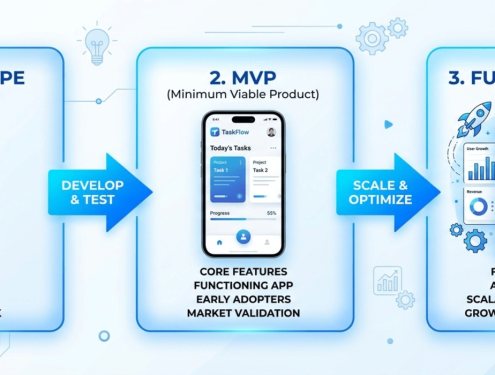
Once you’ve confirmed people want it, build the smallest possible version that solves the core problem. This is called a minimum viable product, or MVP. It does not need every feature you imagine. It needs to work for the one problem you validated.
If you have zero technical background, you have more options today than ever before:
- No-code tools like Bubble, Webflow, or Softr let you build working apps and websites without writing code.
- AI builder tools like Lovable or Bolt let you describe your idea in plain English and get a working prototype in minutes.
- Freelancers on platforms like Upwork can build a simple version for a fixed price if you need something no-code tools can’t handle.
- Spreadsheets and manual tools can act as a temporary “backend” while you prove the idea works.
Keep the first version simple. A functional but plain product that reaches real users beats a polished one that takes a year to finish.
Learn Just Enough, Not Everything
You don’t need to master coding, finance, or marketing before launching. You need to learn just enough to make the next decision. This is one of the biggest mindset shifts for a first-time founder.
Focus your learning on:
- Your specific customer — talk to them constantly, more than any course could teach you
- Basic finances — understand what it costs to run your business and what you need to charge
- How to explain your product simply — if you can’t describe it in one sentence, customers won’t understand it either
Skip trying to become an expert in everything at once. Learn what the current stage of your business actually requires, and move forward.
Surround Yourself With People Who’ve Done It Before
You don’t need years of personal experience if you have access to people who do. Founders with zero experience close the gap fastest by building a support network early.
- Join startup communities, both online and local meetups, to meet other founders navigating the same challenges
- Find a mentor, someone a few steps ahead of you, who can point out mistakes before you make them
- Consider an advisor or informal co-founder with specific experience you’re missing, such as technical development or fundraising
- Use accelerators or incubators, many of which are designed specifically for first-time founders and offer structured guidance
Talking to founders who’ve already made the early mistakes is often faster than learning everything the hard way yourself.
Set Up the Business Basics
Once your idea has real traction, formalize the business side. This part doesn’t require technical skill either, just organization:
- Register your business structure (many first-time founders start with a simple LLC or sole proprietorship)
- Open a separate business bank account so your finances stay organized from day one
- Use simple accounting tools like QuickBooks or Wave to track income and expenses
- Set up basic project management and communication tools to keep yourself and any early hires organized
Note: business registration and tax requirements vary by state and country, so it’s worth checking with a licensed accountant or attorney before making formal decisions.
Launch, Get Feedback, and Improve
Launch to a small group first — the people you interviewed during validation, your personal network, and relevant online communities. Don’t wait for a big audience or perfect timing.
Watch how people actually use the product, not just what they say about it. Early feedback will show you exactly what to fix next. Expect to make changes. Most successful startups look different after a few months than they did on launch day, and that’s a normal, healthy part of the process.
Common Mistakes First-Time Founders Make
- Waiting until they feel “ready.” No one ever feels fully ready. Experience is built by launching, not before it.
- Skipping validation. Building first and asking questions later is the single biggest reason first-time startups fail.
- Trying to do everything alone. Even experienced founders lean on mentors, communities, and specialists. Zero experience doesn’t mean zero support.
- Overspending early. Bootstrap with personal savings or early revenue before seeking outside investors, and only raise funding once you have real evidence the idea works.
- Ignoring the money question. If people won’t pay anything for your product, that’s a signal to rework your idea, not push forward blindly.
Final Thoughts
You can absolutely launch a tech startup with zero experience. What matters isn’t your resume — it’s whether you understand a real problem, validate it honestly, build a simple first version, and keep learning as you go. Every experienced founder started exactly where you are now: with an idea, no track record, and a decision to start anyway.
Pick a problem you understand. Talk to real people. Build small. Learn as you go. That’s the entire playbook, and it works whether you’re 22 or 52, and whether this is your first business or your fifth.

 Web Development
 Mobile App Development
 Software Development
 Digital Marketing & Growth
 UI/UX & Graphic Design
 Cybersecurity & IT Infrastructure
 AI, Data & Automation
 Cloud & DevOps Services