Think you need to know how to code before you can start a company? You don’t. Every year, thousands of people build a startup without technical skills and turn simple ideas into real, paying businesses. Brian Chesky and Joe Gebbia had no coding background when they started Airbnb. They were designers. Sara Blakely wasn’t an engineer when she built Spanx into a billion-dollar brand. What they had was something more valuable than code: a clear problem to solve and the drive to solve it.
This guide walks you through exactly how a non-technical founder can go from idea to launch. No computer science degree is required.
Why Not Knowing How to Code Isn’t a Dealbreaker
For a long time, people believed you needed a technical co-founder to start a tech company. That belief is outdated. Here’s why.
Coding is just one tool for turning an idea into a product. It’s not the idea itself, and it’s not what makes customers want to buy. What makes a startup succeed is:
- A real problem that people will pay to solve
- A deep understanding of your customer
- The ability to sell, market, and build trust
- Persistence to keep improving after launch
Technical founders sometimes fall in love with technology itself. They build complex features nobody asked for. A non-technical founder, on the other hand, is forced to stay focused on the customer, because that’s the only tool they have. That focus often becomes a real advantage.
There’s also a numbers argument here. Coding skills are becoming more common every year through bootcamps, online courses, and AI coding assistants. But people who deeply understand a market know how to sell and can build genuine customer relationships are much harder to find. That kind of knowledge doesn’t come from a course. If you already have it, you’re closer to launching a startup than you think.
Step 1: Find a Problem Worth Solving
Every successful startup starts with a problem, not a piece of software. Before you build anything, clear on:
- Who has this problem? (Be specific — “busy parents” is too broad; “parents of toddlers who need weekend activity ideas” is specific)
- How are they solving it today?
- Would they pay for a better solution, and how much?
Talk to real people. Interview at least 15-20 potential customers before building anything. Ask about their frustrations, not your idea. If people describe the same pain point again, you’ve found something worth building.
Step 2: Validate Before You Build
This is the step most first-time founders skip, and it’s the most important one. Validation means proving people want your idea before you spend time or money building it.
You can validate an idea without any code at all:
- Build a simple landing page describing your product and collect email signups
- Create a survey using a tool like Typeform to test interest
- Pre-sell your product and see if people will pay before it even exists
- Run a manual version of your service yourself, using spreadsheets and email, before automating anything
If nobody signs up, pays, or responds, that’s valuable information. It’s much cheaper to learn that now than after months of building.
Step 3: Build Your First Product with No-Code Tools
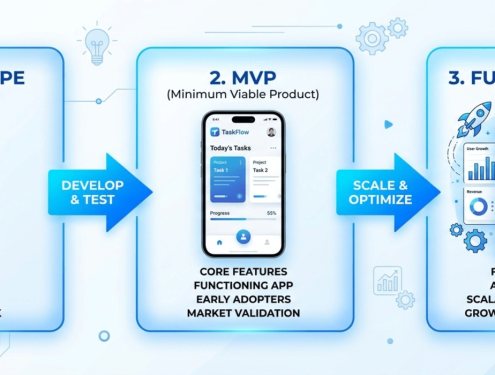
Once you’ve validated demand, it’s time to build a working version of your product, called a minimum viable product (MVP). This used to require hiring developers and spending tens of thousands of dollars. Today, no-code tools let you build a working app, website, or platform yourself.
Here are some of the most popular options, matched by what you’re building:
What You’re Building | Tool to Use | Learning Curve |
Landing page | Carrd, Framer | Under an hour |
Full website | Webflow | A few hours |
App with logins and databases (SaaS) | Bubble | A few days |
Online marketplace | Sharetribe | A few days |
Online store | Shopify | A few hours |
Surveys and signups | Typeform | Under an hour |
Payments | Stripe | Under an hour |
There are also newer AI-powered builders, like Lovable and Bolt, that let you describe your product in plain English and get a working prototype back in minutes. These are especially useful for testing an idea quickly before investing more time.
The goal at this stage isn’t perfection. Your first version should work well enough to solve the core problem. It doesn’t need to look beautiful, and it doesn’t need every feature you can imagine. Focus on the one thing your product needs to do well.
Step 4: Set Up Payments from Day One
Don’t give your product away for free just because you’re not confident yet. Charging money, even a small amount, is the clearest sign that people genuinely value what you built. It’s much stronger proof than compliments or “I’d definitely use this.”
Tools like Stripe make it simple to add payments to almost any website or app without writing code. Set a price, even a modest one, and let real transactions guide your next decisions.
Step 5: Launch to a Small Audience First
You don’t need a massive audience to start. Share your product with:
- People you have already interviewed during validation
- Your personal and professional network
- Relevant online communities and forums where your target customer spends time
Watch how people use your product, not just what they say about it. Early users will show you what’s confusing, what’s missing, and what they love. Use that feedback to improve quickly. Most successful companies pivot, or change direction, at least once based on this kind of early feedback.
Step 6: Know When to Bring Technical Help
At some point, your product may outgrow what no-code tools can do, or you’ll want a more robust, scalable system. That’s the right time to bring in technical talent, not before.
Why wait? If you hire a technical co-founder or developer too early, before you’ve proven anyone wants your product, you risk giving away a large chunk of your company for an idea that might still change. Founders who bring on technical help after validating demand negotiate from a position of strength. You’ll also have a much clearer, more specific list of what needs to be built, which makes hiring far more effective.
When you’re ready, you have a few options:
- Freelance developers for specific, defined projects
- Development agencies for faster, more polished work (at a higher cost)
- A technical co-founder if you want a long-term, equity-sharing partner
- No-code specialists who can extend your existing no-code product
Choose the option that matches your budget, timeline, and how complex your product has become.
Common Mistakes Non-Technical Founders Should Avoid
- Building before validating. It’s tempting to jump straight to building, but skipping validation is the most common reason startups fail.
- Trying to serve everyone. Startups that succeed usually solve one specific problem for one specific type of customer before expanding.
- Giving away equity too early. Don’t offer a large ownership stake to a technical co-founder before you’ve proven your idea works.
- Chasing perfection. A working, imperfect product that reaches real customers beats a polished product that never launches.
- Ignoring the money question. If people won’t pay, even a small amount, treat that as a signal to rethink your approach.
Final Thoughts
You don’t need to be a programmer to build a real company. What you need is a genuine problem to solve, the discipline to validate your idea before building it, and the willingness to use today’s no-code and AI tools to bring it to life. Being a non-technical founder isn’t a weakness to work around — for many successful companies, it’s been the reason they stayed focused on what matters: the customer.
Start small. Validate first. Build with the tools available to you. The barrier that is used to stop non-technical founders from starting a tech company has never been lower than it is right now.

 Web Development
 Mobile App Development
 Software Development
 Digital Marketing & Growth
 UI/UX & Graphic Design
 Cybersecurity & IT Infrastructure
 AI, Data & Automation
 Cloud & DevOps Services